
Security tools > 0xdea/augur
Reverse engineering assistant that extracts strings and related pseudo-code from a binary file
augur








"In fact, I've actually triggered buffer overflows by just entering my real name."
-- A.
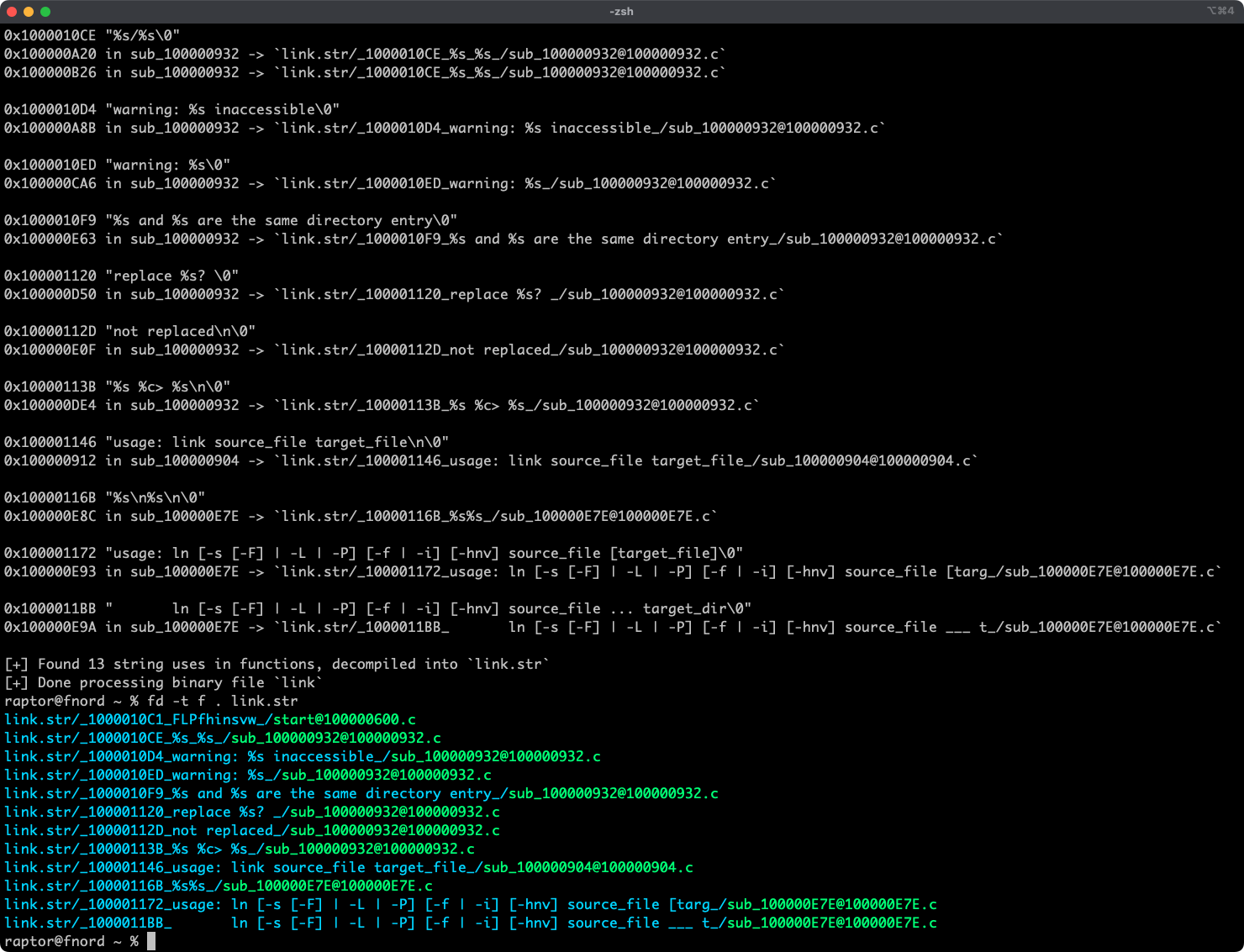
Augur is a blazing fast IDA Pro headless plugin that extracts strings and related pseudocode from a binary file. It stores pseudocode of functions that reference strings in an organized directory tree.
Features
- Blazing fast, headless user experience courtesy of IDA Pro 9.x and Binarly's idalib Rust bindings.
- Support for binary targets for any architecture implemented by IDA Pro's Hex-Rays decompiler.
- Decompilation feature based on the
decompile_to_fileAPI exported by haruspex. - Pseudocode of each function that references a specific string is stored in a separate directory.
Blog posts
- https://hex-rays.com/blog/streamlining-vulnerability-research-idalib-rust-bindings
- https://hnsecurity.it/blog/streamlining-vulnerability-research-with-ida-pro-and-rust
See also
- https://github.com/0xdea/rhabdomancer
- https://github.com/0xdea/haruspex
- https://docs.hex-rays.com/release-notes/9_0#headless-processing-with-idalib
- https://github.com/idalib-rs/idalib
Installing
The easiest way to get the latest release is via crates.io:
- Download, install, and configure IDA Pro (see https://hex-rays.com/ida-pro).
- Install LLVM/Clang (see https://rust-lang.github.io/rust-bindgen/requirements.html).
- On Linux/macOS, install as follows:
On Windows, instead, use the following commands:export IDADIR=/path/to/ida # if not set, the build script will check common locations cargo install augur$env:LIBCLANG_PATH="\path\to\clang+llvm\bin" $env:PATH="\path\to\ida;$env:PATH" $env:IDADIR="\path\to\ida" # if not set, the build script will check common locations cargo install augur
Compiling
Alternatively, you can build from source:
- Download, install, and configure IDA Pro (see https://hex-rays.com/ida-pro).
- Install LLVM/Clang (see https://rust-lang.github.io/rust-bindgen/requirements.html).
- On Linux/macOS, compile as follows:
On Windows, instead, use the following commands:git clone --depth 1 https://github.com/0xdea/augur cd augur export IDADIR=/path/to/ida # if not set, the build script will check common locations cargo build --releasegit clone --depth 1 https://github.com/0xdea/augur cd augur $env:LIBCLANG_PATH="\path\to\clang+llvm\bin" $env:PATH="\path\to\ida;$env:PATH" $env:IDADIR="\path\to\ida" # if not set, the build script will check common locations cargo build --release
Usage
- Make sure IDA Pro is properly configured with a valid license.
- Run as follows:
augur <binary_file> - Find the extracted pseudocode of each decompiled function in the
binary_file.strdirectory, organized by string:vim <binary_file>.str code <binary_file>.str
Compatibility
Only the latest IDA Pro release is officially supported, but older versions may work as well. The following table summarizes the latest compatible release for each IDA Pro version:
| IDA Pro version | Latest compatible release |
|---|---|
| v9.0.241217 | v0.2.3 |
| v9.1.250226 | v0.6.2 |
| v9.2.250908 | v0.7.5 |
| v9.3.260213 | v0.8.1 |
| v9.3.260327 | v0.9.0 |
| v9.3.260421 | current release |
[!NOTE] Check the idalib documentation for additional information.
Changelog
TODO
- Integrate with oneiromancer.
- Allow users to choose to process string cross-references even if the decompiler is unavailable.
- Consider converting
traverse_xrefsto an iterative walk to avoid potential stack overflows and infinite loops. - Consider integrating proptest to complement unit testing.
- Implement functionality similar to https://github.com/joxeankoret/idamagicstrings.