
Miscellaneous Tools > TabGAN
Synthetic tabular data generation using GANs, Diffusion Models, and LLMs with adversarial filtering and privacy metrics.
TabGAN
High-quality synthetic tabular data generation







Overview
TabGAN provides a unified Python interface for generating synthetic tabular data using multiple state-of-the-art generative approaches:
| Approach | Backend | Strengths |
|---|---|---|
| GANs | Conditional Tabular GAN (CTGAN) | Mixed data types, complex multivariate distributions |
| Diffusion Models | ForestDiffusion (tree-based gradient boosting) | High-fidelity generation for structured data |
| Large Language Models | GReaT framework | Capturing semantic dependencies, conditional text generation |
| Baseline | Random sampling with replacement | Quick benchmarking and comparison |
All generators share a common pipeline: generate → post-process → adversarial filter, ensuring synthetic data stays close to the real data distribution.
Based on the paper: Tabular GANs for uneven distribution (arXiv:2010.00638)
Key Features
- Unified API — switch between GANs, diffusion models, and LLMs with a single parameter change
- Adversarial filtering — built-in LightGBM-based validation keeps synthetic samples distribution-consistent
- Mixed data types — native handling of continuous, categorical, and free-text columns
- Conditional generation — generate text conditioned on categorical attributes via LLM prompting
- LLM API support — integrate with LM Studio, OpenAI, Ollama, or any OpenAI-compatible endpoint
- Quality validation — compare original and synthetic distributions with a single function call
- AutoSynth — automatically run all generators, compare quality & privacy, pick the best one
- HuggingFace integration — synthesize any HF dataset in one call, push results back to Hub
- Live Demo — try it in browser on HuggingFace Spaces
Installation
pip install tabgan
Quick Start
import pandas as pd
import numpy as np
from tabgan.sampler import GANGenerator

train = pd.DataFrame(np.random.randint(-10, 150, size=(150, 4)), columns=list("ABCD"))
target = pd.DataFrame(np.random.randint(0, 2, size=(150, 1)), columns=list("Y"))
test = pd.DataFrame(np.random.randint(0, 100, size=(100, 4)), columns=list("ABCD"))

new_train, new_target = GANGenerator().generate_data_pipe(train, target, test)
Available Generators
| Generator | Description | Best For |
|---|---|---|
GANGenerator |
CTGAN-based generation | General tabular data with mixed types |
ForestDiffusionGenerator |
Diffusion models with tree-based methods | Complex tabular structures |
BayesianGenerator |
Gaussian Copula with marginal preservation | Fast, correlation-preserving generation |
LLMGenerator |
Large Language Model based | Semantic dependencies, text columns |
OriginalGenerator |
Baseline random sampler | Benchmarking and comparison |
API Reference
Common Parameters
All generators accept the following parameters:
| Parameter | Type | Default | Description |
|---|---|---|---|
gen_x_times |
float |
1.1 |
Multiplier for synthetic sample count relative to training size |
cat_cols |
list |
None |
Column names to treat as categorical |
bot_filter_quantile |
float |
0.001 |
Lower quantile for post-processing filters |
top_filter_quantile |
float |
0.999 |
Upper quantile for post-processing filters |
is_post_process |
bool |
True |
Enable quantile-based post-filtering |
pregeneration_frac |
float |
2 |
Oversampling factor before filtering |
only_generated_data |
bool |
False |
Return only synthetic rows (exclude originals) |
gen_params |
dict |
See below | Generator-specific hyperparameters |
Generator-Specific Parameters (gen_params)
GANGenerator:
{"batch_size": 500, "patience": 25, "epochs": 500}
LLMGenerator:
{"batch_size": 32, "epochs": 4, "llm": "distilgpt2", "max_length": 500}
generate_data_pipe Method
new_train, new_target = generator.generate_data_pipe(
    train_df,           # pd.DataFrame - training features
    target,             # pd.DataFrame - target variable (or None)
    test_df,            # pd.DataFrame - test features for distribution alignment
    deep_copy=True,     # bool - copy input DataFrames
    only_adversarial=False,  # bool - skip generation, only filter
    use_adversarial=True,    # bool - enable adversarial filtering
)
Returns: Tuple[pd.DataFrame, pd.DataFrame] — (new_train, new_target)
Data Format
TabGAN accepts pandas.DataFrame inputs with:
- Continuous columns — any real-valued numerical data
- Categorical columns — discrete columns with a finite set of values
Note: TabGAN processes values as floating-point internally. Apply rounding after generation for integer-valued outputs.
Examples
Basic Usage with All Generators
from tabgan.sampler import (
    OriginalGenerator, GANGenerator, ForestDiffusionGenerator,
    BayesianGenerator, LLMGenerator,
)
import pandas as pd
import numpy as np

train = pd.DataFrame(np.random.randint(-10, 150, size=(150, 4)), columns=list("ABCD"))
target = pd.DataFrame(np.random.randint(0, 2, size=(150, 1)), columns=list("Y"))
test = pd.DataFrame(np.random.randint(0, 100, size=(100, 4)), columns=list("ABCD"))

new_train1, new_target1 = OriginalGenerator().generate_data_pipe(train, target, test)
new_train2, new_target2 = GANGenerator(
    gen_params={"batch_size": 500, "epochs": 10, "patience": 5}
).generate_data_pipe(train, target, test)
new_train3, new_target3 = ForestDiffusionGenerator().generate_data_pipe(train, target, test)
new_train4, new_target4 = BayesianGenerator().generate_data_pipe(train, target, test)
new_train5, new_target5 = LLMGenerator(
    gen_params={"batch_size": 32, "epochs": 4, "llm": "distilgpt2", "max_length": 500}
).generate_data_pipe(train, target, test)
Full Parameter Example
new_train, new_target = GANGenerator(
    gen_x_times=1.1,
    cat_cols=None,
    bot_filter_quantile=0.001,
    top_filter_quantile=0.999,
    is_post_process=True,
    adversarial_model_params={
        "metrics": "AUC", "max_depth": 2, "max_bin": 100,
        "learning_rate": 0.02, "random_state": 42, "n_estimators": 100,
    },
    pregeneration_frac=2,
    only_generated_data=False,
    gen_params={"batch_size": 500, "patience": 25, "epochs": 500},
).generate_data_pipe(
    train, target, test,
    deep_copy=True,
    only_adversarial=False,
    use_adversarial=True,
)
LLM Conditional Text Generation
Generate synthetic rows with novel text values conditioned on categorical attributes:
import pandas as pd
from tabgan.sampler import LLMGenerator

train = pd.DataFrame({
    "Name": ["Anna", "Maria", "Ivan", "Sergey", "Olga", "Boris"],
    "Gender": ["F", "F", "M", "M", "F", "M"],
    "Age": [25, 30, 35, 40, 28, 32],
    "Occupation": ["Engineer", "Doctor", "Artist", "Teacher", "Manager", "Pilot"],
})

new_train, _ = LLMGenerator(
    gen_x_times=1.5,
    text_generating_columns=["Name"],      # columns to generate novel text for
    conditional_columns=["Gender"],         # columns that condition text generation
    gen_params={"batch_size": 32, "epochs": 4, "llm": "distilgpt2", "max_length": 500},
    is_post_process=False,
).generate_data_pipe(train, target=None, test_df=None, only_generated_data=True)
How it works:
- Sample conditional column values from their empirical distributions
- Impute remaining non-text columns using the fitted GReaT model
- Generate novel text via prompt-based generation
- Ensure generated text values differ from the original data
LLM API-Based Text Generation
Use external LLM APIs (LM Studio, OpenAI, Ollama) instead of local models:
import pandas as pd
from tabgan.sampler import LLMGenerator
from tabgan.llm_config import LLMAPIConfig

train = pd.DataFrame({
    "Name": ["Anna", "Maria", "Ivan", "Sergey", "Olga", "Boris"],
    "Gender": ["F", "F", "M", "M", "F", "M"],
    "Age": [25, 30, 35, 40, 28, 32],
    "Occupation": ["Engineer", "Doctor", "Artist", "Teacher", "Manager", "Pilot"],
})

# LM Studio
api_config = LLMAPIConfig.from_lm_studio(
    base_url="http://localhost:1234",
    model="google/gemma-3-12b",
    timeout=90,
)

# Or OpenAI:  LLMAPIConfig.from_openai(api_key="...", model="gpt-4")
# Or Ollama:  LLMAPIConfig.from_ollama(model="llama3")

new_train, _ = LLMGenerator(
    gen_x_times=1.5,
    text_generating_columns=["Name"],
    conditional_columns=["Gender"],
    gen_params={"batch_size": 32, "epochs": 4, "llm": "distilgpt2", "max_length": 500},
    llm_api_config=api_config,
    is_post_process=False,
).generate_data_pipe(train, target=None, test_df=None, only_generated_data=True)
LLM API Configuration Options
| Parameter | Type | Default | Description |
|---|---|---|---|
base_url |
str |
"http://localhost:1234" |
API server base URL |
model |
str |
"google/gemma-3-12b" |
Model identifier |
api_key |
str |
None |
API key for authentication |
timeout |
int |
90 |
Request timeout in seconds |
max_tokens |
int |
256 |
Maximum tokens to generate |
temperature |
float |
0.7 |
Sampling temperature |
system_prompt |
str |
None |
System prompt for generation |
Testing the connection:
from tabgan.llm_config import LLMAPIConfig
from tabgan.llm_api_client import LLMAPIClient

config = LLMAPIConfig.from_lm_studio()
with LLMAPIClient(config) as client:
    print(f"API available: {client.check_connection()}")
    print(f"Generated: {client.generate('Generate a female name: ')}")
Improving Model Performance
import sklearn
import pandas as pd
from tabgan.sampler import GANGenerator

def evaluate(clf, X_train, y_train, X_test, y_test):
    clf.fit(X_train, y_train)
    return sklearn.metrics.roc_auc_score(y_test, clf.predict_proba(X_test)[:, 1])

dataset = sklearn.datasets.load_breast_cancer()
clf = sklearn.ensemble.RandomForestClassifier(n_estimators=25, max_depth=6)
X_train, X_test, y_train, y_test = sklearn.model_selection.train_test_split(
    pd.DataFrame(dataset.data),
    pd.DataFrame(dataset.target, columns=["target"]),
    test_size=0.33, random_state=42,
)

print("Baseline:", evaluate(clf, X_train, y_train, X_test, y_test))

new_train, new_target = GANGenerator().generate_data_pipe(X_train, y_train, X_test)
print("With GAN:", evaluate(clf, new_train, new_target, X_test, y_test))
Time-Series Data Generation
import pandas as pd
import numpy as np
from tabgan.utils import get_year_mnth_dt_from_date, collect_dates
from tabgan.sampler import GANGenerator

train = pd.DataFrame(np.random.randint(-10, 150, size=(100, 4)), columns=list("ABCD"))
min_date, max_date = pd.to_datetime("2019-01-01"), pd.to_datetime("2021-12-31")
d = (max_date - min_date).days + 1
train["Date"] = min_date + pd.to_timedelta(np.random.randint(d, size=100), unit="d")
train = get_year_mnth_dt_from_date(train, "Date")

new_train, _ = GANGenerator(
    gen_x_times=1.1, cat_cols=["year"],
    bot_filter_quantile=0.001, top_filter_quantile=0.999,
    is_post_process=True, pregeneration_frac=2,
).generate_data_pipe(train.drop("Date", axis=1), None, train.drop("Date", axis=1))

new_train = collect_dates(new_train)
Quality Report
Generate a self-contained HTML report comparing original and synthetic data across multiple quality axes: column statistics, PSI, correlation heatmaps, distribution plots, and ML utility (TSTR vs TRTR).
from tabgan import QualityReport

report = QualityReport(
    original_df, synthetic_df,
    cat_cols=["gender"],
    target_col="target",      # enables ML utility evaluation
).compute()

# Export to a single HTML file (charts embedded as base64)
report.to_html("quality_report.html")

# Or access metrics programmatically
summary = report.summary()
print(f"Overall score: {summary['overall_score']}")
print(f"Mean PSI: {summary['psi']['mean']}")
print(f"ML utility ratio: {summary['ml_utility']['utility_ratio']}")
For a quick comparison without the full report:
from tabgan.utils import compare_dataframes

score = compare_dataframes(original_df, generated_df)  # 0.0 (poor) to 1.0 (excellent)
Constraints
Enforce business rules on generated data. Constraints are applied as a post-generation step — invalid rows are repaired or filtered out.
from tabgan import GANGenerator, RangeConstraint, UniqueConstraint, FormulaConstraint, RegexConstraint

new_train, new_target = GANGenerator(gen_x_times=1.5).generate_data_pipe(
    train, target, test,
    constraints=[
        RangeConstraint("age", min_val=0, max_val=120),
        UniqueConstraint("email"),
        FormulaConstraint("end_date > start_date"),
        RegexConstraint("zip_code", r"\d{5}"),
    ],
)
Available constraints:
| Constraint | Description | Fix strategy |
|---|---|---|
RangeConstraint |
Numeric values within [min, max] |
Clips values to bounds |
UniqueConstraint |
No duplicate values in a column | Drops duplicate rows |
FormulaConstraint |
Boolean expression via df.eval() |
Filters violating rows |
RegexConstraint |
String values match a regex pattern | Filters non-matching rows |
The ConstraintEngine supports two strategies: "fix" (repair then filter) and "filter" (drop violations only):
from tabgan import ConstraintEngine, RangeConstraint

engine = ConstraintEngine(
    constraints=[RangeConstraint("price", min_val=0)],
    strategy="fix",  # or "filter"
)
cleaned_df = engine.apply(generated_df)
Privacy Metrics
Assess re-identification risk of synthetic data before sharing. Includes Distance to Closest Record (DCR), Nearest Neighbor Distance Ratio (NNDR), and membership inference risk.
from tabgan import PrivacyMetrics

pm = PrivacyMetrics(original_df, synthetic_df, cat_cols=["gender"])
summary = pm.summary()

print(f"Overall privacy score: {summary['overall_privacy_score']}")  # 0 (risky) to 1 (private)
print(f"DCR mean: {summary['dcr']['mean']}")
print(f"NNDR mean: {summary['nndr']['mean']}")
print(f"Membership inference AUC: {summary['membership_inference']['auc']}")  # closer to 0.5 = better
Metrics explained:
| Metric | What it measures | Good value |
|---|---|---|
| DCR | Distance from each synthetic row to nearest real row | Higher = more private |
| NNDR | Ratio of 1st/2nd nearest neighbor distances | Closer to 1.0 |
| MI AUC | Can a classifier tell if a record was in training data? | Closer to 0.5 |
sklearn Pipeline Integration
Use TabGANTransformer to insert synthetic data augmentation into an sklearn Pipeline:
from sklearn.pipeline import Pipeline
from sklearn.ensemble import RandomForestClassifier
from tabgan import TabGANTransformer

pipe = Pipeline([
    ("augment", TabGANTransformer(gen_x_times=1.5, cat_cols=["gender"])),
    ("model", RandomForestClassifier()),
])

# fit() generates synthetic data and trains the model on augmented data
pipe.fit(X_train, y_train)
Works with any generator and supports constraints:
from tabgan import TabGANTransformer, GANGenerator, RangeConstraint

transformer = TabGANTransformer(
    generator_class=GANGenerator,
    gen_x_times=2.0,
    gen_params={"batch_size": 500, "epochs": 10, "patience": 5},
    constraints=[RangeConstraint("age", min_val=0, max_val=120)],
)

X_augmented = transformer.fit_transform(X_train, y_train)
y_augmented = transformer.get_augmented_target()
AutoSynth
Don't know which generator works best for your data? AutoSynth runs all of them and picks the winner based on quality and privacy scores:
from tabgan import AutoSynth

result = AutoSynth(df, target_col="label").run()

print(result.report)
#   Generator          Status  Score  Quality  Privacy  Rows  Time (s)
# 0 GAN (CTGAN)        OK      0.847  0.891    0.743    165   12.3
# 1 Forest Diffusion   OK      0.812  0.834    0.761    165   45.1
# 2 Random Baseline    OK      0.654  0.621    0.732    165   0.1

best_synthetic = result.best_data
print(f"Winner: {result.best_name}")
Customize scoring weights:
result = AutoSynth(
    df,
    target_col="label",
    quality_weight=0.5,   # equal weight
    privacy_weight=0.5,
).run()
HuggingFace Hub Integration
Synthesize any tabular dataset from HuggingFace Hub in one call:
from tabgan import synthesize_hf_dataset

# Load → Generate → Evaluate automatically
result = synthesize_hf_dataset("scikit-learn/iris", target_col="target")
print(result.synthetic_df.head())
print(f"Quality: {result.quality_summary['overall_score']}")

# Push synthetic dataset back to Hub
result = synthesize_hf_dataset(
    "scikit-learn/iris",
    target_col="target",
    push_to_hub=True,
    hub_repo_id="your-username/iris-synthetic",
)
Command-Line Interface
tabgan-generate \
    --input-csv train.csv \
    --target-col target \
    --generator gan \
    --gen-x-times 1.5 \
    --cat-cols year,gender \
    --output-csv synthetic_train.csv
Pipeline Architecture
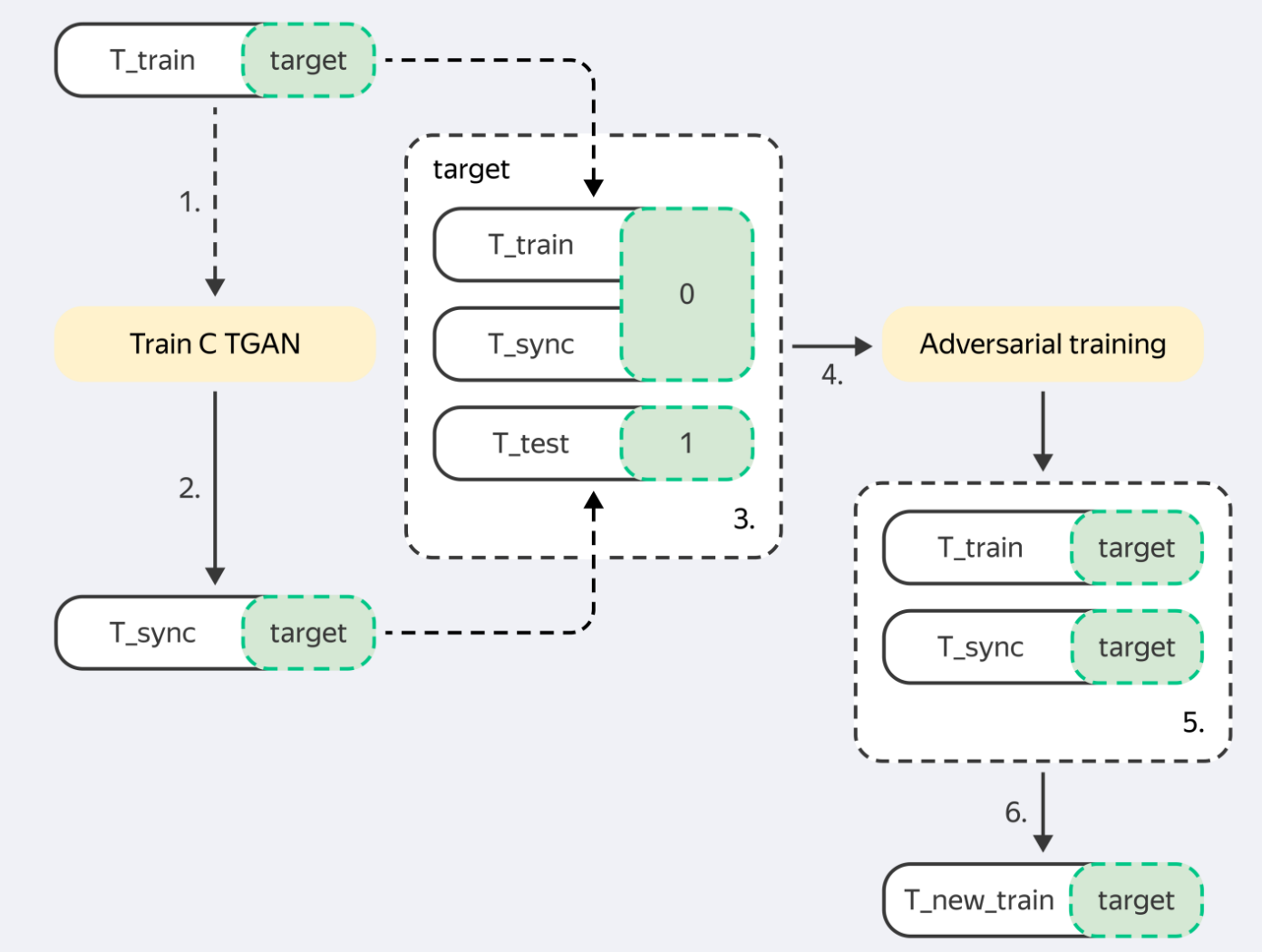
Input (train_df, target, test_df)
  |
  v
[Preprocess] --> Validate DataFrames, prepare columns
  |
  v
[Generate]  --> CTGAN / ForestDiffusion / GReaT LLM / Random sampling
  |
  v
[Post-process] --> Quantile-based filtering against test distribution
  |
  v
[Adversarial Filter] --> LightGBM classifier removes dissimilar samples
  |
  v
Output (synthetic_df, synthetic_target)
Benchmark Results
Normalized ROC AUC scores (higher is better):
| Dataset | No augmentation | GAN | Sample Original |
|---|---|---|---|
| credit | 0.997 | 0.998 | 0.997 |
| employee | 0.986 | 0.966 | 0.972 |
| mortgages | 0.984 | 0.964 | 0.988 |
| poverty_A | 0.937 | 0.950 | 0.933 |
| taxi | 0.966 | 0.938 | 0.987 |
| adult | 0.995 | 0.967 | 0.998 |
Citation
@misc{ashrapov2020tabular,
    title={Tabular GANs for uneven distribution},
    author={Insaf Ashrapov},
    year={2020},
    eprint={2010.00638},
    archivePrefix={arXiv},
    primaryClass={cs.LG}
}
References
- Xu, L., & Veeramachaneni, K. (2018). Synthesizing Tabular Data using Generative Adversarial Networks. arXiv:1811.11264.
- Jolicoeur-Martineau, A., Fatras, K., & Kachman, T. (2023). Generating and Imputing Tabular Data via Diffusion and Flow-based Gradient-Boosted Trees. SamsungSAILMontreal/ForestDiffusion.
- Xu, L., Skoularidou, M., Cuesta-Infante, A., & Veeramachaneni, K. (2019). Modeling Tabular data using Conditional GAN. NeurIPS.
- Borisov, V., Sessler, K., Leemann, T., Pawelczyk, M., & Kasneci, G. (2023). Language Models are Realistic Tabular Data Generators. ICLR.
License
Apache License 2.0 — see LICENSE for details.