
Databases Implemented in Go > NoKV
Native metadata service for distributed filesystems, object storage, and AI dataset workloads.

An open-source namespace metadata substrate for distributed filesystems, object storage, and AI dataset metadata.








What is NoKV?
NoKV is the metadata substrate that filesystems, object storage, and AI dataset layers shouldn't have to build themselves.
Meta Tectonic uses ZippyDB. Google Colossus uses Spanner. DeepSeek 3FS uses FoundationDB. Each big-tech system extracted a separate metadata layer from its data layer — because grafting namespace semantics onto a generic KV is the part that breaks under scale.
NoKV is that layer, open-sourced and namespace-native: server-side ReadDirPlus / WatchSubtree / SnapshotSubtree / RenameSubtree, formally-verified authority handoff, sub-second prefix-scoped change feeds. You bring the data plane (FUSE driver, S3 frontend, dataset SDK); NoKV owns namespace truth.
Where it sits: NoKV is the layer above generic KV (FoundationDB / TiKV / etcd) and below filesystem-shaped consumers (CephFS / JuiceFS / S3 gateways / AI training pipelines). Apache-2.0.
Why namespace metadata is its own layer, not a feature you bolt onto generic KV:
Server-side namespace primitives.
ReadDirPlusreturns one directory + N child stats in one round-trip; client-side stitching on a generic KV does 1+N round-trips with a 42× end-to-end latency penalty (measured on the same NoKV cluster — see Headline Evidence).WatchSubtreeships a prefix-scoped change feed at 178 ms p50, vs. client-side prefix scans on key-range watches.Namespace correctness is its own class. Subtree authority handoff, mount lifecycle, snapshot epoch, and quota fence have a formal correctness model that generic KV doesn't speak. NoKV's Eunomia protocol is TLC-model-checked under finite bounds for handoff legality — a property no general-purpose KV provides because it isn't a general-purpose KV property.
Bring your own data plane. NoKV does not store object bytes, chunk data, or POSIX file content. You wire it under a FUSE driver, an S3 gateway, or a dataset SDK; NoKV is the namespace truth those frontends consume. This is the layer split Meta / Google / DeepSeek already chose internally — extracted, packaged, and Apache-2.0.
Three audiences that all sit on the same substrate:
- 🗂️ Distributed filesystems — DFS frontends (FUSE / NFS / SMB drivers, JuiceFS / CubeFS-style services) consume
fsmetafor inode / dentry / mount / subtree authority instead of writing their own metadata layer on top of Redis / TiKV / FoundationDB - 🪣 Object storage namespace layers — S3-compatible gateways consume the same
fsmetafor bucket / prefix / version metadata, getting fastLIST(server-sideReadDirPlus) and prefix-scoped event streams without client-side stitching - 🧪 AI dataset metadata — checkpoint storms (atomic multi-key
AssertionNotExist), dataset versioning (SnapshotSubtree), prefix-scoped change feeds for training pipelines (WatchSubtree) — without retrofitting them onto a generic KV
NoKV does for namespace metadata what etcd did for cluster state: a purpose-built coordination layer instead of forcing engineers to re-derive namespace semantics on every project.
📊 Headline Evidence
Underlying KV layer (YCSB single-node, NoKV vs Badger / Pebble)
Apple M3 Pro · records=1M · ops=1M · value_size=1000 · conc=16
| Workload | Description | NoKV | Badger | Pebble |
|---|---|---|---|---|
| YCSB-A | 50/50 read/update | 175,905 | 108,232 | 169,792 |
| YCSB-B | 95/5 read/update | 525,631 | 188,893 | 137,483 |
| YCSB-C | 100% read | 409,136 | 242,463 | 90,474 |
| YCSB-D | 95% read, 5% insert (latest) | 632,031 | 284,205 | 198,139 |
| YCSB-E | 95% scan, 5% insert | 45,620 | 15,027 | 40,793 |
| YCSB-F | read-modify-write | 157,732 | 84,601 | 122,192 |
Units: ops/sec. Full latency in
benchmark/README.md. Single-node localhost, not multi-host production.
🧭 Why NoKV vs X?
| If you need… | You should probably use… | Where NoKV fits |
|---|---|---|
| A complete distributed filesystem (FUSE-mountable, full POSIX) | CephFS, JuiceFS | NoKV is not an FS — but JuiceFS-style systems default to Redis / TiKV for their metadata backend, which breaks at scale. NoKV can be JuiceFS's metadata backend. |
| A production object store | MinIO, Ceph RGW | NoKV is not an object store — object body I/O isn't its job. NoKV provides the namespace layer above the object backend (bucket / prefix / version) |
| A custom metadata service you're writing on top of FoundationDB / TiKV / etcd | NoKV | This is exactly what NoKV replaces. ReadDirPlus / WatchSubtree / SnapshotSubtree are server-side primitives — you don't have to stitch them client-side. Apache-2.0. |
| A production distributed KV | TiKV, FoundationDB, CockroachDB | NoKV does not compete with them — they own the generic-KV market. NoKV is a metadata-native layer that can run on top of them (or, today, on its own engine) |
| Production distributed SQL | CockroachDB, TiDB | Different scope (relational, not namespace) |
| Just an embedded LSM | Pebble, Badger | NoKV's engine is not a drop-in library |
| A Raft library | etcd/raft, dragonboat | NoKV's raftstore (per-region runtime, transport, membership, snapshot install, apply observer) is built on top of etcd/raft RawNode. Owned: the integration. Reused: the consensus algorithm. |
NoKV's value comes from being metadata-native, not generic-KV-with-metadata-glued-on. The same architectural slice big-tech filesystems already extract internally — ReadDirPlus, prefix-scoped event streams, formally-verified authority handoff — packaged as a layer you can drop in instead of writing yourself.
🏗️ Architecture

🗂️ fsmeta — Namespace Metadata Service
Native API surface (gRPC at nokv-fsmeta:8090, also embedded Go via fsmeta/exec.OpenWithRaftstore):
| Primitive | Semantics |
|---|---|
ReadDirPlus |
Fused directory scan + batch inode fetch under one snapshot, avoiding client-side N+1 metadata reads |
WatchSubtree |
Prefix-scoped live change feed with ready signal, cursor replay, and flow-control acks |
SnapshotSubtree |
MVCC read-version token for stable dataset / bucket / directory views |
RenameSubtree |
Cross-region atomic namespace move backed by Percolator 2PC |
| Basic namespace ops | Create, Lookup, ReadDir, Link, Unlink, quota usage, and mount lifecycle |
Authority lifecycle (rooted in meta/root, managed via nokv mount / nokv quota CLI):
| Domain | Rooted truth | Runtime view |
|---|---|---|
| Mount | MountRegistered / MountRetired (auto-declares era=0 SubtreeAuthority) |
Mount admission cache |
| Subtree authority | SubtreeAuthorityDeclared / SubtreeHandoffStarted / SubtreeHandoffCompleted |
RenameSubtree era frontier |
| Snapshot epoch | SnapshotEpochPublished / SnapshotEpochRetired |
Read-version cache |
| Quota fence | QuotaFenceUpdated (mount + subtree level, bytes + inodes) |
Usage in raftstore (transactional, not in-memory) |
Documentation: docs/fsmeta.md · positioning note · namespace authority events umbrella
🚦 Quick Start
Run a full cluster
# Local processes — meta-root + coordinator + 3-store cluster + fsmeta gateway
./scripts/dev/cluster.sh --config ./raft_config.example.json

# Or: Docker Compose (cluster + fsmeta gateway, with mount-init bootstrap)
docker compose up -d

# Local Docker development build
docker compose up -d --build

# Return to the published image after a local build when available
make docker-up
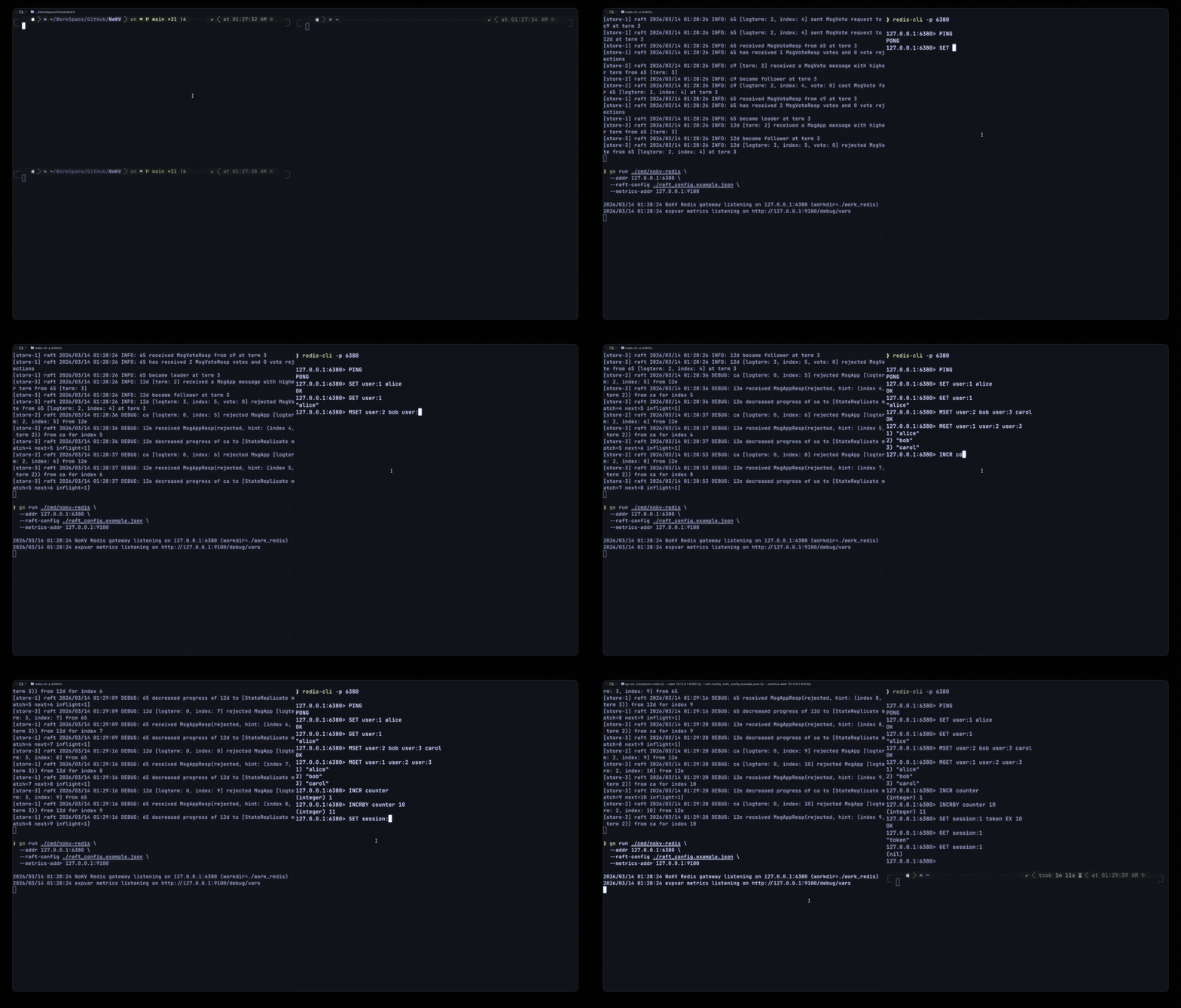
Use fsmeta from Go (embedded — same Executor as the gRPC server)
package main

import (
    "context"

    "github.com/feichai0017/NoKV/fsmeta"
    fsmetaexec "github.com/feichai0017/NoKV/fsmeta/exec"
)

func main() {
    ctx := context.Background()
    rt, err := fsmetaexec.OpenWithRaftstore(ctx, fsmetaexec.Options{
        CoordinatorAddr: "127.0.0.1:2379",
    })
    if err != nil {
        panic(err)
    }
    defer rt.Close()

    // mount must be registered first (see `nokv mount register`)
    err = rt.Executor.Create(ctx, fsmeta.CreateRequest{
        Mount: "default", Parent: 1, Name: "hello.txt", Inode: 100,
    }, fsmeta.InodeRecord{Type: fsmeta.InodeTypeFile, LinkCount: 1, Size: 13})
    if err != nil {
        panic(err)
    }

    page, _ := rt.Executor.ReadDirPlus(ctx, fsmeta.ReadDirRequest{
        Mount: "default", Parent: 1, Limit: 100,
    })
    for _, e := range page {
        println(e.Dentry.Name, e.Inode.Size)
    }
}
Use fsmeta from any language (gRPC)
# Bootstrap a mount (required before first write)
nokv mount register --coordinator-addr 127.0.0.1:2379 \
  --mount default --root-inode 1 --schema-version 1

# Set a quota fence (mount-level)
nokv quota set --coordinator-addr 127.0.0.1:2379 \
  --mount default --limit-bytes 1073741824 --limit-inodes 1000000

# Run the standalone fsmeta gRPC gateway with metrics
nokv-fsmeta --addr 127.0.0.1:8090 --coordinator-addr 127.0.0.1:2379 \
  --metrics-addr 127.0.0.1:9101
Then use any gRPC client against fsmeta.proto (Go typed client at fsmeta/client/).
Inspect runtime state
# Live, via expvar (executor / watch / quota / mount metrics)
curl http://127.0.0.1:9101/debug/vars | jq '.nokv_fsmeta_executor, .nokv_fsmeta_watch, .nokv_fsmeta_quota, .nokv_fsmeta_mount'

# Offline forensics from a stopped node's workdir
nokv stats --workdir ./artifacts/cluster/store-1
nokv manifest --workdir ./artifacts/cluster/store-1
nokv regions --workdir ./artifacts/cluster/store-1 --json
Full guide: docs/getting_started.md · CLI reference: docs/cli.md
🧩 Modules
| Module | Responsibility | Docs |
|---|---|---|
fsmeta/ |
Namespace metadata schema, executor, gRPC service, embedded API | fsmeta |
fsmeta/exec/watch/ |
WatchSubtree router + RemoteSource + catch-up replay | fsmeta |
spec/ |
TLA+ models for control-plane and metadata transition safety | spec/README.md |
meta/root/ |
Typed rooted truth kernel (Delos-lite) | Rooted Truth |
coordinator/ |
Routing, TSO, store discovery, root-event publish, streaming subscribe | Coordinator |
raftstore/ |
Multi-Raft, transport, membership, SST snapshot install, apply observer | RaftStore |
percolator/ |
Distributed MVCC 2PC + AssertionNotExist | Percolator |
engine/lsm/ |
MemTable, flush, leveled compaction, SST | LSM · flush · compaction |
engine/wal/ |
WAL segments, CRC, rotation, replay | WAL |
engine/vlog/ |
KV-separated value log + hash buckets + parallel GC | ValueLog |
engine/manifest/ |
VersionEdit log, atomic CURRENT | Manifest |
engine/vfs/ |
VFS abstraction, FaultFS, cross-platform atomic rename | VFS |
thermos/ |
Hot-key observer | Thermos |
cmd/nokv/ |
CLI: stats, manifest, regions, vlog, migrate, mount, quota | CLI |
cmd/nokv-fsmeta/ |
Standalone fsmeta gRPC gateway | fsmeta |
📡 Observability
Four independent expvar metric namespaces (per-domain admission visibility):
| Endpoint | Metric namespace | Fields |
|---|---|---|
nokv-fsmeta --metrics-addr :PORT/debug/vars |
nokv_fsmeta_executor |
txn_retries_total, txn_retry_exhausted_total |
nokv_fsmeta_watch |
subscribers, events_total, delivered_total, dropped_total, overflow_total |
|
nokv_fsmeta_quota |
checks_total, rejects_total, cache_hits_total, cache_misses_total, fence_updates_total, usage_mutations_total |
|
nokv_fsmeta_mount |
cache_hits, cache_misses, admission_rejects_total |
Plus structured logs from coordinator and each store. More: docs/stats.md · docs/cli.md · docs/testing.md.
🧭 Topology & Configuration
All deployment shapes share one configuration file: raft_config.example.json.
{
  "coordinator": { "addr": "127.0.0.1:2379", ... },
  "stores": [
    { "store_id": 1, "listen_addr": "127.0.0.1:20170", ... },
    { "store_id": 2, "listen_addr": "127.0.0.1:20171", ... },
    { "store_id": 3, "listen_addr": "127.0.0.1:20172", ... }
  ],
  "regions": [
    { "id": 1, "range": [-inf, "m"), "leader": 1, ... },
    { "id": 2, "range": ["m", +inf), "leader": 2, ... }
  ]
}
Local scripts, Docker Compose, and all CLI tools consume the same file. Programmatic access: import "github.com/feichai0017/NoKV/config" and call config.LoadFile / Validate.
🤝 Community
📄 License
Built from scratch — own storage engine, own raftstore on top of
etcd/raft RawNode, own coordinator.