
terravision
Generates professional cloud architecture diagrams from Terraform code using official AWS/Azure/GCP icons and design standards. Runs 100% client-side with CI/CD integration.
TerraVision
Turn Terraform code into professional cloud architecture diagrams that stay in sync with your infrastructure — automatic, secure, living documents







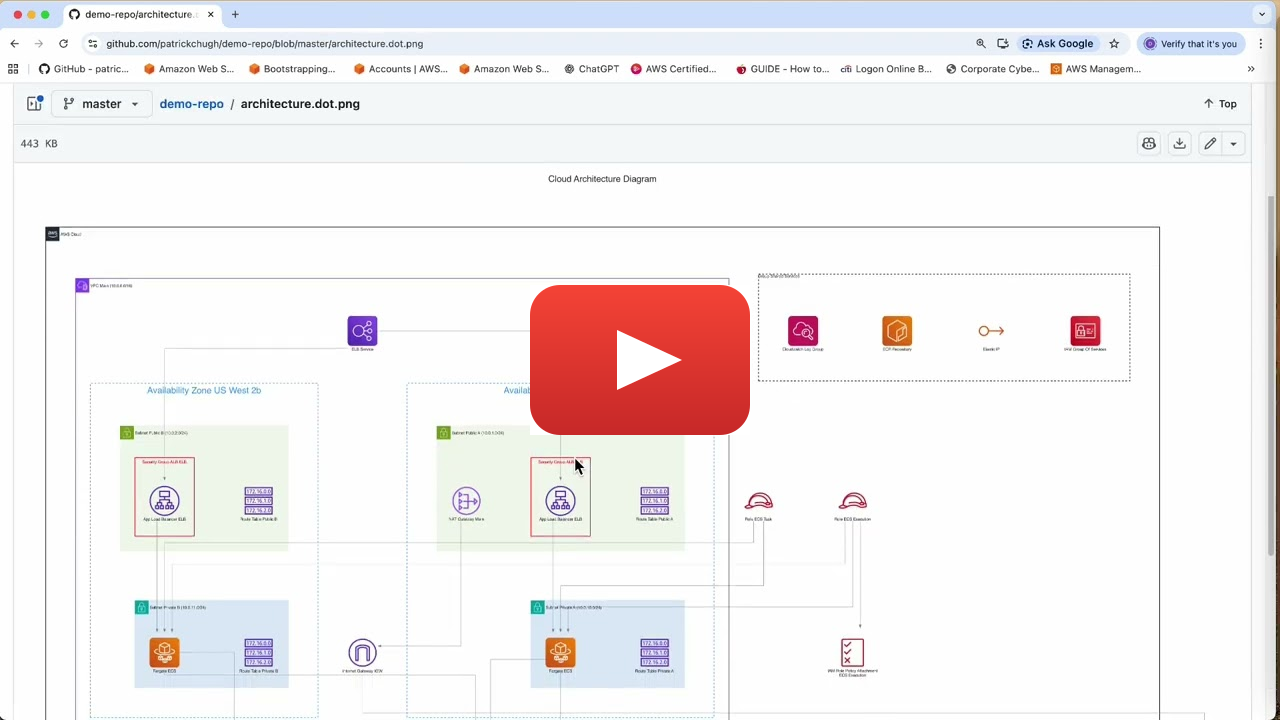
Watch a 4-Minute Intro
What is TerraVision?
TerraVision automatically converts your Terraform code into professional-grade cloud architecture diagrams using the official AWS, GCP, and Azure icon sets. Your diagrams stay in sync with your infrastructure — no more outdated Visio, draw.io or Lucidchart files.
Why TerraVision?
- ✅ Always up-to-date — diagrams generated directly from your Terraform code
- ✅ 100% client-side — no cloud access required, runs locally, your code never leaves your machine
- ✅ CI/CD ready — automate diagram updates on every PR merge
- ✅ Free & open source — no expensive diagramming tool licenses
- ✅ Multi-cloud — AWS (full), GCP, and Azure (core services)
- ✅ Interactive HTML output — clickable nodes, pan/zoom, search, animated data flow
- ✅ Editable draw.io export — open in draw.io, Lucidchart, or any mxGraph editor
- ✅ Optional AI annotations — labels, titles, and flow sequences from Ollama (local) or AWS Bedrock
- ✅ Terragrunt compatible — auto-detects single- and multi-module Terragrunt projects
Supported Cloud Providers
| Provider | Status | Resources |
|---|---|---|
| AWS | ✅ Full support | 200+ services |
| Google Cloud | 🔄 Partial support | Core services |
| Azure | 🔄 Partial support | Core services |
Quick Start
Install
pipx install terravision # or: pip install terravision if in a virtual env
You also need Python 3.10+, Terraform 1.x, Graphviz, and Git. See the Installation Guide for platform-specific instructions, Docker, and Nix.
Generate your first diagram
git clone https://github.com/patrickchugh/terravision.git
cd terravision

# EKS cluster example
terravision draw --source tests/fixtures/aws_terraform/eks_automode --show

# Azure VM scale set
terravision draw --source tests/fixtures/azure_terraform/test_vm_vmss --show

# From a public Git repo (note the // for subfolder)
terravision draw --source https://github.com/patrickchugh/terraform-examples.git//aws/wordpress_fargate --show
That's it — your diagram is saved as architecture.png and opens automatically.
Generate an interactive HTML diagram
terravision visualise --source ./path-to-your-terraform --show
Click any resource to see its Terraform metadata, search resources, pan/zoom, and watch animated data flow on edges. The HTML is a single self-contained file that works fully offline.
Try the Interactive Demos
Click any of these to see the interactive HTML output TerraVision produces:
- 🟧 AWS demo — Wordpress on ECS Fargate with CloudFront, RDS, EFS
- 🟦 Azure demo — VM scale set with load balancer and VNet
- 🟩 GCP demo — Core GCP networking and compute
Basic Usage
Generate a diagram
# From a local directory
terravision draw --source ./path-to-your-terraform

# From a Git repository
terravision draw --source https://github.com/user/repo.git

# Custom format and filename
terravision draw --source ./path-to-your-terraform --format svg --outfile my-architecture

# Editable draw.io file
terravision draw --source ./path-to-your-terraform --format drawio --outfile my-architecture
Use a pre-generated Terraform plan (no cloud credentials needed)
# Step 1: in your Terraform environment
terraform plan -out=tfplan.bin
terraform show -json tfplan.bin > plan.json
terraform graph > graph.dot

# Step 2: diagram generation, no Terraform or cloud access required
terravision draw --planfile plan.json --graphfile graph.dot --source ./path-to-your-terraform
AI-powered annotations (optional)
terravision draw --source ./path-to-your-terraform --ai-annotate ollama   # local LLM (no data leaves your machine)
terravision draw --source ./path-to-your-terraform --ai-annotate bedrock  # AWS Bedrock via boto3 (uses your AWS credentials)
terravision draw --source ./path-to-your-terraform --ai-annotate restapi  # any OpenAI-compatible endpoint (OpenAI, LiteLLM, vLLM, ...)
Only metadata and the summary graph are sent to the LLM — never your .tf source. The bedrock backend authenticates via the standard AWS credential chain (no infrastructure to deploy); restapi is configured via TV_RESTAPI_URL, TV_RESTAPI_KEY, and TV_RESTAPI_MODEL. See the Annotations Guide and AI-Powered Annotations for the full configuration.
Simplified view
terravision draw --source ./path-to-your-terraform --simplified
Strips VPCs, subnets, and networking plumbing. Great for executive presentations.
Common options
terravision --help shows full help text details.
| Option | Description | Example |
|---|---|---|
--source |
Terraform directory or Git URL | ./path-to-your-terraform |
--format |
Output format: png, svg, pdf, drawio, and more |
svg |
--outfile |
Output filename | my-architecture |
--workspace |
Terraform workspace | production |
--varfile |
Variable file (repeatable) | prod.tfvars |
--planfile |
Pre-generated plan JSON | plan.json |
--graphfile |
Pre-generated graph DOT | graph.dot |
--ai-annotate |
AI annotation backend | ollama, bedrock, restapi |
--simplified |
High-level view (no networking) | (flag) |
--show |
Open after generation | (flag) |
Documentation
The complete documentation lives at patrickchugh.github.io/terravision.
For users:
For contributors:
FAQ
Common questions — cloud credentials, LLM data privacy, offline use, Terragrunt, output formats, and more — are answered in the FAQ on the documentation site.
Contributing
Contributions are very welcome. See CONTRIBUTING.md for development setup, coding standards, and the PR process.
Support
- Issues: GitHub Issues
- Discussions: GitHub Discussions
- Documentation: patrickchugh.github.io/terravision
License
See LICENSE.
Acknowledgments
- Graphviz — diagram rendering
- Terraform — infrastructure parsing
- Terragrunt — multi-module orchestration
- Cloud provider icons from official AWS, GCP, and Azure icon sets