
Observability > kpod-metrics
eBPF-based pod-level kernel metrics collector for Kubernetes. Exports per-pod CPU, network, memory, syscall, disk I/O, and L7 protocol metrics to Prometheus. BPF programs are defined using a Kotlin DSL instead of C.
kpod-metrics




eBPF-based pod-level kernel metrics collector for Kubernetes. Runs as a DaemonSet, attaches eBPF programs to kernel tracepoints, and exports per-pod CPU, network, memory, syscall, disk I/O, and filesystem metrics to Prometheus.
Demo
Architecture
Node (DaemonSet pod)
┌─────────────────────────────────────────────────┐
│  Spring Boot (JDK 21 + Virtual Threads)         │
│                                                  │
│  MetricsCollectorService (every 30s default)    │
│  ├── eBPF Collectors ──► JNI ──► BPF Maps      │
│  │   ├── CpuSchedulingCollector                 │
│  │   ├── NetworkCollector                       │
│  │   ├── MemoryCollector                        │
│  │   ├── SyscallCollector                       │
│  │   ├── BiolatencyCollector                    │
│  │   ├── CachestatCollector                     │
│  │   ├── TcpdropCollector                       │
│  │   ├── HardirqsCollector                      │
│  │   ├── SoftirqsCollector                      │
│  │   ├── ExecsnoopCollector                     │
│  │   └── BpfMapStatsCollector                   │
│  └── Cgroup Collectors ──► /sys/fs/cgroup       │
│      ├── DiskIOCollector                        │
│      ├── InterfaceNetworkCollector              │
│      ├── FilesystemCollector                    │
│      └── MemoryCgroupCollector                  │
│                                                  │
│  PodWatcher (K8s informer, node-scoped)         │
│  CgroupResolver (cgroup ID → pod metadata)      │
│  Prometheus exporter (:9090/actuator/prometheus) │
└─────────────────────────────────────────────────┘
         │ JNI (libkpod_bpf.so)
    ┌────▼────────────────────────┐
    │ Linux Kernel                │
    │ ├── cpu_sched.bpf.o        │
    │ ├── net.bpf.o              │
    │ ├── mem.bpf.o              │
    │ └── syscall.bpf.o          │
    │                             │
    │ Tracepoints: sched_switch,  │
    │ tcp_sendmsg, oom_kill,      │
    │ sys_enter/exit, ...         │
    └─────────────────────────────┘
eBPF programs are defined in Kotlin using kotlin-ebpf-dsl, which generates both the C code for kernel-side programs and Kotlin MapReader classes for userspace deserialization. Programs are compiled once with CO-RE (Compile Once, Run Everywhere) using kernel BTF, so no per-kernel compilation is needed.
Metrics
All metrics are labeled with namespace, pod, container, and node.
eBPF Metrics
| Metric | Type | Description |
|---|---|---|
kpod.cpu.runqueue.latency |
DistributionSummary | Time spent waiting in the CPU run queue (seconds) |
kpod.cpu.context.switches |
Counter | Context switch count |
kpod.net.tcp.bytes.sent |
Counter | TCP bytes sent |
kpod.net.tcp.bytes.received |
Counter | TCP bytes received |
kpod.net.tcp.retransmits |
Counter | TCP retransmissions |
kpod.net.tcp.connections |
Counter | TCP connection count |
kpod.net.tcp.rtt |
DistributionSummary | TCP round-trip time (seconds) |
kpod.mem.oom.kills |
Counter | OOM kill events |
kpod.mem.major.page.faults |
Counter | Major page faults |
kpod.syscall.count |
Counter | Syscall invocations (+ syscall label) |
kpod.syscall.errors |
Counter | Syscall errors (+ syscall label) |
kpod.syscall.latency |
DistributionSummary | Syscall latency (+ syscall label) |
kpod.net.tcp.drops |
Counter | TCP packet drops |
kpod.disk.io.latency |
DistributionSummary | Block I/O latency (seconds) |
kpod.mem.cache.accesses |
Counter | Page cache accesses |
kpod.mem.cache.additions |
Counter | Page cache additions (misses) |
kpod.mem.cache.dirtied |
Counter | Page cache dirty pages |
kpod.mem.cache.buf.dirtied |
Counter | Buffer cache dirty pages |
kpod.irq.hw.latency |
DistributionSummary | Hardware interrupt latency (seconds) |
kpod.irq.hw.count |
Counter | Hardware interrupt count |
kpod.irq.sw.latency |
DistributionSummary | Software interrupt latency (seconds) |
kpod.proc.execs |
Counter | Process exec events |
kpod.proc.forks |
Counter | Process fork events |
kpod.proc.exits |
Counter | Process exit events |
Cgroup Metrics
| Metric | Type | Extra Labels | Description |
|---|---|---|---|
kpod.disk.read.bytes |
Counter | device |
Bytes read from disk |
kpod.disk.written.bytes |
Counter | device |
Bytes written to disk |
kpod.disk.reads |
Counter | device |
Read operation count |
kpod.disk.writes |
Counter | device |
Write operation count |
kpod.net.iface.rx.bytes |
Counter | interface |
Interface bytes received |
kpod.net.iface.tx.bytes |
Counter | interface |
Interface bytes transmitted |
kpod.net.iface.rx.packets |
Counter | interface |
Interface packets received |
kpod.net.iface.tx.packets |
Counter | interface |
Interface packets transmitted |
kpod.net.iface.rx.errors |
Counter | interface |
Interface receive errors |
kpod.net.iface.tx.errors |
Counter | interface |
Interface transmit errors |
kpod.net.iface.rx.drops |
Counter | interface |
Interface receive drops |
kpod.net.iface.tx.drops |
Counter | interface |
Interface transmit drops |
kpod.fs.capacity.bytes |
Gauge | mountpoint |
Filesystem total capacity |
kpod.fs.usage.bytes |
Gauge | mountpoint |
Filesystem used bytes |
kpod.fs.available.bytes |
Gauge | mountpoint |
Filesystem available bytes |
Memory Cgroup Metrics
| Metric | Type | Description |
|---|---|---|
kpod.mem.cgroup.usage.bytes |
Gauge | Current memory usage |
kpod.mem.cgroup.peak.bytes |
Gauge | Peak memory usage |
kpod.mem.cgroup.cache.bytes |
Gauge | Page cache usage |
kpod.mem.cgroup.swap.bytes |
Gauge | Swap usage |
Pod Lifecycle Metrics
| Metric | Type | Labels | Description |
|---|---|---|---|
kpod.container.restarts |
Gauge | container |
Container restart count from K8s API |
Self-Monitoring Metrics
| Metric | Type | Labels | Description |
|---|---|---|---|
kpod.collection.cycle.duration |
Timer | — | Full collection cycle duration |
kpod.collector.duration |
Timer | collector |
Per-collector execution time |
kpod.collector.errors.total |
Counter | collector |
Per-collector failure count |
kpod.collector.skipped.total |
Counter | collector |
Interval-based collector skips |
kpod.collection.timeouts.total |
Counter | — | Collection timeout count |
kpod.discovery.pods.total |
Gauge | — | Discovered pods per cycle |
kpod.cgroup.read.errors |
Counter | collector |
Cgroup read failures |
kpod.bpf.program.load.duration |
Timer | program |
BPF program load time at startup |
BPF Map Diagnostics
| Metric | Type | Labels | Description |
|---|---|---|---|
kpod.bpf.map.entries |
Gauge | map |
Current entry count in BPF map |
kpod.bpf.map.capacity |
Gauge | map |
Max entries per map (10240) |
kpod.bpf.map.update.errors.total |
Counter | map |
BPF map update failures |
Profiles
Control which metrics are collected via the kpod.profile setting:
| Collector | minimal | standard | comprehensive |
|---|---|---|---|
| CPU scheduling | yes | yes | yes |
| Network TCP (eBPF) | - | yes | yes |
| TCP drops (eBPF) | - | yes | yes |
| Memory OOM | yes | yes | yes |
| Memory page faults | - | yes | yes |
| Block I/O latency (eBPF) | - | yes | yes |
| Page cache stats (eBPF) | - | yes | yes |
| Hardware IRQ latency (eBPF) | - | - | yes |
| Software IRQ latency (eBPF) | - | - | yes |
| Process exec/fork/exit (eBPF) | - | - | yes |
| Syscall tracing | - | - | yes |
| Disk I/O (cgroup) | yes | yes | yes |
| Interface network (cgroup) | - | yes | yes |
| Filesystem (cgroup) | - | yes | yes |
Estimated cardinality per pod: minimal ~20, standard ~39, comprehensive ~69 time series.
Prerequisites
- Linux kernel 4.18+ (5.2+ recommended for CO-RE/BTF)
- Cgroup v2 (default on Kubernetes 1.25+)
- Kubernetes 1.19+
The image ships two sets of compiled BPF programs. At startup, kpod-metrics checks for /sys/kernel/btf/vmlinux and automatically loads the appropriate set.
Kernel Version Support
| Kernel | Mode | How it works |
|---|---|---|
| 5.2+ | CO-RE (recommended) | Uses BTF for portable BPF loading. All features supported. Most distros since RHEL 8.2, Ubuntu 20.04, Debian 11. |
| 4.18–5.1 | Legacy | Uses pre-compiled BPF programs with fixed struct offsets. All features supported, but BPF objects are not relocatable across kernel builds with non-standard tracepoint layouts. |
| < 4.18 | Not supported | Missing bpf_get_current_cgroup_id() helper required for per-pod attribution. |
Limitations of legacy mode (4.18–5.1):
- Tracepoint context struct layouts are assumed to match the stable kernel ABI. Custom or patched kernels that alter tracepoint format fields may cause incorrect data or load failures.
- No automatic struct relocation — if a field offset changes, the BPF program must be recompiled with an updated
compat_vmlinux.h.
How to verify your kernel supports kpod-metrics:
# Check kernel version
uname -r

# Check if BTF is available (5.2+ with CONFIG_DEBUG_INFO_BTF=y)
ls /sys/kernel/btf/vmlinux

# Check cgroup v2
mount | grep cgroup2
Required kernel config (typically enabled by default on modern distros):
CONFIG_BPF=y
CONFIG_BPF_SYSCALL=y
CONFIG_BPF_JIT=y
CONFIG_DEBUG_INFO_BTF=y  # Required only for CO-RE path; optional on 4.18+
Quick Start
Deploy with Helm
helm repo add kpod-metrics https://pjs7678.github.io/kpod-metrics
helm repo update
helm install kpod-metrics kpod-metrics/kpod-metrics \
  --namespace kpod-metrics --create-namespace
Or from a local clone:
helm install kpod-metrics ./helm/kpod-metrics \
  --namespace kpod-metrics --create-namespace
Try It Locally (kind)
Spin up a local demo cluster with a single command:
./scripts/quickstart.sh
This creates a kind cluster, installs kpod-metrics, and sets up port-forwarding so you can immediately view metrics. Run ./scripts/quickstart.sh --cleanup to tear it down.
Verify
# Check the DaemonSet is running
kubectl -n kpod-metrics get pods

# Check metrics are being exported
kubectl -n kpod-metrics port-forward ds/kpod-metrics 9090:9090
curl http://localhost:9090/actuator/prometheus | grep kpod
Service Topology
Auto-discovered service dependency graph from eBPF TCP peer data — no configuration, no sidecars.
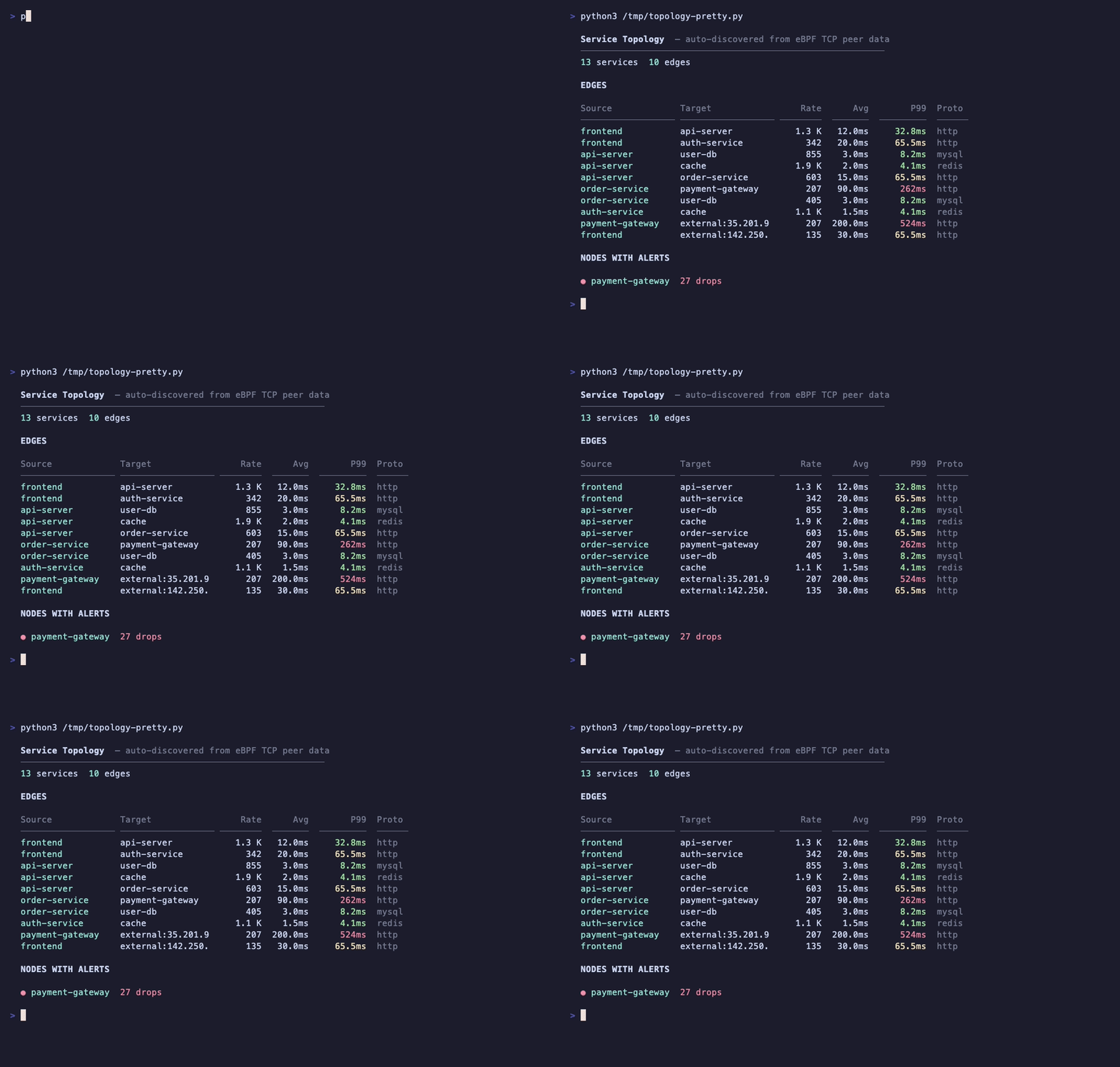
Edges show avg + p99 latency, request rate, and auto-detected protocol. Nodes show aggregated traffic, protocol mix, and TCP drops. See docs/topology.md for details.
# View topology API
kubectl -n kpod-metrics port-forward ds/kpod-metrics 9090:9090
curl http://localhost:9090/actuator/kpodTopology | python3 -m json.tool
Grafana Dashboard
A ready-made Grafana dashboard is included with 9 rows covering all metric categories. It auto-provisions via the Grafana sidecar when deployed with Helm:
grafana:
  dashboard:
    enabled: true   # default
    label: "1"      # matches Grafana sidecar default
For non-Helm setups, import grafana/kpod-metrics-dashboard.json directly via the Grafana UI.
Prometheus Operator
For clusters running the Prometheus Operator, enable the ServiceMonitor and PrometheusRule:
serviceMonitor:
  enabled: true
  interval: 30s

prometheusRule:
  enabled: true
This provisions 18 alerting rules including: high runqueue latency, TCP retransmits/drops, syscall error rate, filesystem full, BPF map health, container restart rate, crash loop detection, memory pressure, collector skip rate, and fork/exec bomb detection. Plus 17 recording rules for precomputed p50/p90/p99 aggregations.
OTLP Export
Push metrics to any OpenTelemetry-compatible collector alongside Prometheus scraping:
otlp:
  enabled: true
  endpoint: "http://otel-collector:4318/v1/metrics"
  headers:
    api-key: "my-api-key"
  step: 60000   # push interval in ms
When enabled, an OtlpMeterRegistry is created that pushes all kpod metrics via OTLP/HTTP. This works in parallel with Prometheus scraping — both registries receive the same metrics.
Configuration
All settings are under the kpod.* prefix. Configure via Helm values or environment variables.
Helm Values
image:
  repository: ghcr.io/pjs7678/kpod-metrics
  tag: "1.11.0"

resources:
  requests:
    cpu: 150m
    memory: 256Mi
  limits:
    cpu: 500m
    memory: 512Mi

config:
  profile: standard          # minimal | standard | comprehensive | custom
  pollInterval: 30000        # Collection interval in ms
  discovery:
    mode: informer           # informer (K8s API) or kubelet (Kubelet API)
    kubeletPollInterval: 30  # seconds, for kubelet mode
  cgroup:
    root: /sys/fs/cgroup
    procRoot: /host/proc

grafana:
  dashboard:
    enabled: true            # Deploy Grafana dashboard ConfigMap
    label: "1"               # Sidecar label selector value

serviceMonitor:
  enabled: false             # Requires Prometheus Operator CRDs
  interval: 30s
  scrapeTimeout: 10s

prometheusRule:
  enabled: false             # Requires Prometheus Operator CRDs
Key Properties
| Property | Default | Description |
|---|---|---|
kpod.profile |
standard |
Metric collection profile |
kpod.poll-interval |
30000 |
Base collection interval (ms) |
kpod.collection-timeout |
20000 |
Max time per collection cycle (ms) |
kpod.initial-delay |
10000 |
Delay before first collection (ms) |
kpod.node-name |
${NODE_NAME} |
Node name for metric tags |
kpod.cluster-name |
"" |
Cluster name for multi-cluster tag |
kpod.discovery.mode |
informer |
Pod discovery: informer or kubelet |
kpod.filter.namespaces |
[] (all) |
Namespaces to include (empty = all) |
kpod.filter.exclude-namespaces |
kube-system, kube-public |
Namespaces to skip |
kpod.filter.label-selector |
"" |
Label selector (key=value, key!=value, key) |
kpod.filter.include-labels |
app, app.kubernetes.io/name, ... |
Pod labels to include as metric tags |
kpod.bpf.enabled |
true |
Enable eBPF programs |
kpod.otlp.enabled |
false |
Enable OTLP metrics export |
kpod.otlp.endpoint |
http://localhost:4318/v1/metrics |
OTLP collector endpoint |
kpod.otlp.headers |
{} |
OTLP request headers (e.g., API keys) |
kpod.otlp.step |
60000 |
OTLP push interval (ms) |
Per-Collector Intervals
Heavy collectors can run less frequently than the base poll-interval. Set per-collector intervals in milliseconds:
config:
  collectorIntervals:
    syscall: 60000      # every 60s instead of 30s
    biolatency: 60000
    hardirqs: 60000
    softirqs: 60000
Collectors without an explicit interval run every cycle. Use config.collectors.<name>: false to disable a collector entirely.
| kpod.bpf.program-dir | /app/bpf | Path to compiled BPF objects |
| kpod.syscall.tracked-syscalls | read, write, openat, ... | Syscalls to trace (comprehensive profile) |
Building
Docker (recommended)
The build context requires both this repo and kotlin-ebpf-dsl as a sibling directory:
parent/
├── kpod-metrics/
└── kotlin-ebpf-dsl/
docker build -f kpod-metrics/Dockerfile -t kpod-metrics:latest .
The 5-stage Dockerfile handles:
- Codegen -- Gradle runs kotlin-ebpf-dsl to generate BPF C code and Kotlin MapReader classes
- BPF compile -- clang compiles generated
.bpf.cinto both CO-RE (5.2+) and legacy (4.18+).bpf.oobjects - JNI build -- CMake compiles the JNI bridge (
libkpod_bpf.so) against libbpf - App build -- Gradle builds the Spring Boot executable JAR
- Runtime -- Eclipse Temurin JRE 21, minimal image with compiled artifacts
Local Development
Requires JDK 21 and kotlin-ebpf-dsl as a sibling directory:
./gradlew generateBpf  # Generate BPF C code + Kotlin MapReader classes
./gradlew build         # Compile + test (293 tests)
./gradlew bootJar       # Build executable JAR
BPF programs and JNI library must be cross-compiled in a Linux environment (the Dockerfile handles this).
BPF Code Generation
eBPF programs are defined as Kotlin DSL in src/bpfGenerator/kotlin/:
val memProgram = ebpfProgram("mem") {
    val counterKey = struct("counter_key") { u64("cgroup_id") }
    val oomKills = hashMap("oom_kills", counterKey, BpfScalar.U64, maxEntries = 10240)

    tracepoint("oom", "mark_victim") {
        val cgId = getCurrentCgroupId()
        val ptr = mapLookupElem(oomKills, cgId)
        ifNonNull(ptr) { atomicIncrement(it) }
    }
}
Running ./gradlew generateBpf produces:
build/generated/bpf/*.bpf.c-- kernel-side C programsbuild/generated/kotlin/*MapReader.kt-- type-safe map deserialization
Collectors use generated MapReader layout classes instead of manual ByteBuffer parsing:
// Before (manual)
val cgroupId = ByteBuffer.wrap(keyBytes).order(ByteOrder.LITTLE_ENDIAN).long

// After (generated)
val cgroupId = MemMapReader.CounterKeyLayout.decodeCgroupId(keyBytes)
Testing
Unit Tests
./gradlew test # 293 tests
Integration Test (minikube)
# Full test: minikube start, Docker build, Helm deploy, stress test, cleanup
./scripts/test-local-k8s.sh

# Reuse existing minikube and skip Docker build
./scripts/test-local-k8s.sh --skip-minikube --skip-build

# Cleanup only
./scripts/test-local-k8s.sh --teardown
The integration test validates: health endpoint, Prometheus metrics, cgroup collector output, pod stability under stress (zero restarts, <5s scrape latency, <10% error rate). It also runs the E2E test (below) as a non-blocking sub-step.
E2E Test (targeted workloads)
Deploys deterministic workload pods that generate specific kernel events, then asserts that kpod-metrics captures them as Prometheus metrics with correct pod labels.
# Full run: build, deploy, test, cleanup
./e2e/e2e-test.sh --cleanup

# Skip build, use existing image
./e2e/e2e-test.sh --skip-build --cleanup

# Test against an already-running deployment
./e2e/e2e-test.sh --skip-build --skip-deploy
| Flag | Description |
|---|---|
--skip-build |
Skip Docker image build (use existing image) |
--skip-deploy |
Skip helm install (use existing deployment) |
--cleanup |
Full teardown after test (helm uninstall + namespace delete) |
--wait=N |
Override metrics collection wait time in seconds (default: 25) |
--port=N |
Reuse an existing port-forward on this port |
Workloads (deployed to e2e-test namespace):
| Pod | Kernel Activity | Metrics Verified |
|---|---|---|
e2e-cpu-worker |
4 busy-loop forks, 100m CPU limit | kpod_cpu_context_switches_total |
e2e-net-server / e2e-net-client |
TCP connect/send loop | kpod_net_tcp_connections_total, kpod_net_iface_rx_bytes_total |
e2e-syscall-worker |
Tight cat /proc/self/status loop |
kpod_syscall_count_total |
e2e-mem-worker |
dd 10MB allocations |
kpod_fs_usage_bytes |
eBPF-based assertions are warn-only (BPF programs may not load on minikube). Cgroup-based assertions are required to pass.
Scaling
Tested for clusters up to 1,000 nodes / 100,000 pods.
| Component | Capacity |
|---|---|
| BPF map entries | 10,240 per map (LRU, auto-evicts) |
| API server load | 1 node-scoped watch per node |
| Batch JNI | Single syscall per map read |
| Kernel memory | ~15-20 MB per node |
| Collection cycle | ~500-1000ms per node |
For large clusters, use the standard profile (not comprehensive) to keep Prometheus cardinality under 4M time series.
Project Structure
kpod-metrics/
├── bpf/
│   ├── vmlinux.h               # Kernel BTF headers for CO-RE
│   └── compat_vmlinux.h        # Minimal header for legacy (non-CO-RE) builds
├── jni/
│   ├── bpf_bridge.c            # JNI bridge (libbpf wrapper)
│   └── CMakeLists.txt
├── src/
│   ├── bpfGenerator/kotlin/    # eBPF program definitions (Kotlin DSL)
│   │   └── .../bpf/programs/
│   │       ├── Structs.kt      # Shared BPF struct definitions
│   │       ├── MemProgram.kt
│   │       ├── CpuSchedProgram.kt
│   │       ├── NetProgram.kt
│   │       ├── SyscallProgram.kt
│   │       └── GenerateBpf.kt  # Code generation entry point
│   ├── main/kotlin/
│   │   └── com/internal/kpodmetrics/
│   │       ├── bpf/            # BpfBridge, BpfProgramManager, CgroupResolver
│   │       ├── cgroup/         # CgroupReader, CgroupPathResolver
│   │       ├── collector/      # All metric collectors (eBPF + cgroup)
│   │       ├── config/         # MetricsProperties, profiles, auto-configuration
│   │       ├── discovery/      # PodProvider, PodCgroupMapper
│   │       ├── k8s/            # PodWatcher (K8s informer)
│   │       └── model/          # DTOs
│   └── test/kotlin/            # 293 unit tests
├── grafana/
│   └── kpod-metrics-dashboard.json  # Standalone Grafana dashboard (importable via UI)
├── helm/kpod-metrics/          # Helm chart (DaemonSet, RBAC, ConfigMap)
│   ├── dashboards/
│   │   └── kpod-metrics.json   # Dashboard JSON for Helm-managed ConfigMap
│   └── templates/
│       ├── grafana-dashboard-cm.yaml   # Grafana sidecar ConfigMap
│       ├── servicemonitor.yaml         # Prometheus Operator ServiceMonitor
│       ├── prometheusrule.yaml         # Prometheus Operator alerting rules
│       └── service.yaml                # Headless Service for ServiceMonitor
├── e2e/
│   ├── e2e-test.sh             # E2E targeted workload test
│   └── workloads.yaml          # CPU, network, syscall, memory workload pods
├── scripts/
│   ├── test-local-k8s.sh       # Integration test (minikube)
│   └── stress-workload.yaml
├── Dockerfile                  # 5-stage build (codegen → BPF → JNI → app → runtime)
├── build.gradle.kts
└── settings.gradle.kts         # Composite build with kotlin-ebpf-dsl
Comparison with Similar Tools
| Feature | kpod-metrics | Pixie | Hubble | Inspektor Gadget | Kepler |
|---|---|---|---|---|---|
| Per-pod kernel metrics | yes | yes | network only | per-gadget | energy only |
| eBPF-based | yes | yes | yes | yes | yes |
| Zero config topology | yes | yes | yes | no | no |
| Prometheus-native export | yes | via plugin | via plugin | via plugin | yes |
| OTLP export | yes | no | no | no | no |
| Lightweight DaemonSet | ~256 Mi | ~2 Gi | ~128 Mi | ~128 Mi | ~128 Mi |
| No sidecar required | yes | yes | yes | yes | yes |
| Kernel 4.18+ support | yes (legacy mode) | no (5.2+) | no (5.2+) | no (5.2+) | yes |
| Kotlin eBPF DSL | yes | no (C/C++) | no (C) | no (C) | no (C) |
| Grafana dashboard included | yes | own UI | own UI | no | yes |
| L7 protocol detection | yes (HTTP/Redis/MySQL/Kafka/MongoDB) | yes | yes | per-gadget | no |
When to choose kpod-metrics: You want a lightweight, Prometheus-native pod metrics collector with zero-config service topology, broad kernel support, and type-safe eBPF programs defined in Kotlin instead of C.
Tech Stack
- Runtime: Kotlin 2.1.10, Spring Boot 3.4.3, JDK 21 (virtual threads)
- eBPF: CO-RE programs generated by kotlin-ebpf-dsl, compiled with clang, loaded via libbpf + JNI
- Metrics: Micrometer + Prometheus registry
- K8s: Fabric8 Kubernetes Client 7.1.0
- Build: Gradle 8.12 (composite build), multi-stage Docker
- CI/CD: GitHub Actions — unit tests on PRs, image publish on merge to main
CI/CD
GitHub Actions runs two workflows:
- CI (
ci.yml) — Runs unit tests on every PR and push tomain. Checks out the sibling kotlin-ebpf-dsl repo for the composite Gradle build. - Publish (
publish.yml) — On push tomain, builds the Docker image and pushes toghcr.io/pjs7678/kpod-metricswith:latestand:<sha>tags.
docker pull ghcr.io/pjs7678/kpod-metrics:latest