Internationalization > react-native-languages
React Native properties and methods related to the language of the device
🌍 react-native-localize
A toolbox for your React Native app localization.








Support
This library follows the React Native releases support policy.
It is supporting the latest version, and the two previous minor series.
Setup
$ npm install --save react-native-localize
# --- or ---
$ yarn add react-native-localize
Don't forget to run pod install after that !
Expo plugin
If you're using Expo, you can specify the supported locales in your app.json or app.config.js using the config plugin.
This enables Android 13+ and iOS to display the available locales in the system settings, allowing users to select their preferred language for your app.
Dynamic configuration (app.config.js, app.config.ts)
import type { ConfigContext, ExpoConfig } from "expo/config";
import localize from "react-native-localize/expo"; // use `require` in app.config.js

export default ({ config }: ConfigContext): ExpoConfig => ({
  plugins: [
    localize({
      locales: ["en", "fr"], // or { android: ["en"], ios: ["en", "fr"] }
    }),
  ],
});
Static configuration (app.json)
{
  "expo": {
    "plugins": [
      [
        "react-native-localize",
        {
          "locales": ["en", "fr"], // or { android: ["en"], ios: ["en", "fr"] }
        },
      ],
    ],
  },
}
Web support
This package supports react-native-web. Follow their official guide to configure webpack.
Basic usage example
import { getCurrencies, getLocales } from "react-native-localize";

console.log(getLocales());
console.log(getCurrencies());
API
getCalendar()
Returns the user preferred calendar format.
Method type
type getCalendar = () =>
  | "gregorian"
  | "buddhist"
  | "coptic"
  | "ethiopic"
  | "ethiopic-amete-alem"
  | "hebrew"
  | "indian"
  | "islamic"
  | "islamic-umm-al-qura"
  | "islamic-civil"
  | "islamic-tabular"
  | "iso8601"
  | "japanese"
  | "persian";
Usage example
import { getCalendar } from "react-native-localize";

console.log(getCalendar());
// -> "gregorian"
getCountry()
Returns the user current country code (based on its device locale, not on its position).
Method type
type getCountry = () => string;
Usage example
import { getCountry } from "react-native-localize";

console.log(getCountry());
// -> "FR"
Note
Devices using Latin American regional settings will return "UN" instead of "419", as the latter is not a standard country code.
getCurrencies()
Returns the user preferred currency codes, in order.
Method type
type getCurrencies = () => string[];
Usage example
import { getCurrencies } from "react-native-localize";

console.log(getCurrencies());
// -> ["EUR", "GBP", "USD"]
getLocales()
Returns the user preferred locales, in order.
Method type
type getLocales = () => Array<{
  languageCode: string;
  scriptCode?: string;
  countryCode: string;
  languageTag: string;
  isRTL: boolean;
}>;
Usage example
import { getLocales } from "react-native-localize";

console.log(getLocales());
/* -> [
  { countryCode: "GB", languageTag: "en-GB", languageCode: "en", isRTL: false },
  { countryCode: "US", languageTag: "en-US", languageCode: "en", isRTL: false },
  { countryCode: "FR", languageTag: "fr-FR", languageCode: "fr", isRTL: false },
] */
getNumberFormatSettings()
Returns number formatting settings.
Method type
type getNumberFormatSettings = () => {
  decimalSeparator: string;
  groupingSeparator: string;
};
Usage example
import { getNumberFormatSettings } from "react-native-localize";

console.log(getNumberFormatSettings());
/* -> {
  decimalSeparator: ".",
  groupingSeparator: ",",
} */
getTemperatureUnit()
Returns the user preferred temperature unit.
Method type
type getTemperatureUnit = () => "celsius" | "fahrenheit";
Usage example
import { getTemperatureUnit } from "react-native-localize";

console.log(getTemperatureUnit());
// -> "celsius"
getTimeZone()
Returns the user preferred timezone (based on its device settings, not on its position).
Method type
type getTimeZone = () => string;
Usage example
import { getTimeZone } from "react-native-localize";

console.log(getTimeZone());
// -> "Europe/Paris"
uses24HourClock()
Returns true if the user prefers 24h clock format, false if they prefer 12h clock format.
Method type
type uses24HourClock = () => boolean;
Usage example
import { uses24HourClock } from "react-native-localize";

console.log(uses24HourClock());
// -> true
usesMetricSystem()
Returns true if the user prefers metric measure system, false if they prefer imperial.
Method type
type usesMetricSystem = () => boolean;
Usage example
import { usesMetricSystem } from "react-native-localize";

console.log(usesMetricSystem());
// -> true
usesAutoDateAndTime()
Tells if the automatic date & time setting is enabled on the phone. Android only
Method type
type usesAutoDateAndTime = () => boolean | undefined;
Usage example
import { usesAutoDateAndTime } from "react-native-localize";

console.log(usesAutoDateAndTime()); // true or false
usesAutoTimeZone()
Tells if the automatic time zone setting is enabled on the phone. Android only
Method type
type usesAutoTimeZone = () => boolean | undefined;
Usage example
import { usesAutoTimeZone } from "react-native-localize";

console.log(usesAutoTimeZone());
findBestLanguageTag()
Returns the best language tag possible and its reading direction. Useful to pick the best translation available.
[!NOTE]
It respects the user preferred languages list order (see explanations).
Method type
type findBestLanguageTag = (
  languageTags: string[],
) => { languageTag: string; isRTL: boolean } | undefined;
Usage example
import { findBestLanguageTag } from "react-native-localize";

console.log(findBestLanguageTag(["en-US", "en", "fr"]));
// -> { languageTag: "en-US", isRTL: false }
openAppLanguageSettings()
Opens the app language settings.
[!WARNING]
This feature is available only on Android 13+ and require configuring your app's supported locales.
Method type
type openAppLanguageSettings = () => Promise<void>;
Usage example
import { openAppLanguageSettings } from "react-native-localize";

openAppLanguageSettings("application").catch((error) => {
  console.warn("Cannot open app language settings", error);
});
Server-side rendering
On the client, react-native-localize uses navigator.languages. During SSR, it gets language preferences from the server via the parsed Accept-Language header.
1. Wrap your app with ServerLanguagesProvider
On the server, wrap your app with ServerLanguagesProvider and pass the user's languages:
import accepts from "accepts";
import { ServerLanguagesProvider } from "react-native-localize";

// parse the Accept-Language header; any approach returning string[] is fine
const languages = accepts(request).languages();

const html = renderToString(
  <ServerLanguagesProvider value={languages}>
    <App />
  </ServerLanguagesProvider>,
);
2. Use the useLocalize hook in your components
In your components, use the useLocalize hook instead of calling the API methods directly:
import { useLocalize } from "react-native-localize";

const App = () => {
  const { getCountry } = useLocalize();
  return <Text>Country: {getCountry()}</Text>;
};
Examples with @formatjs/intl
Browse the files in the /example directory.
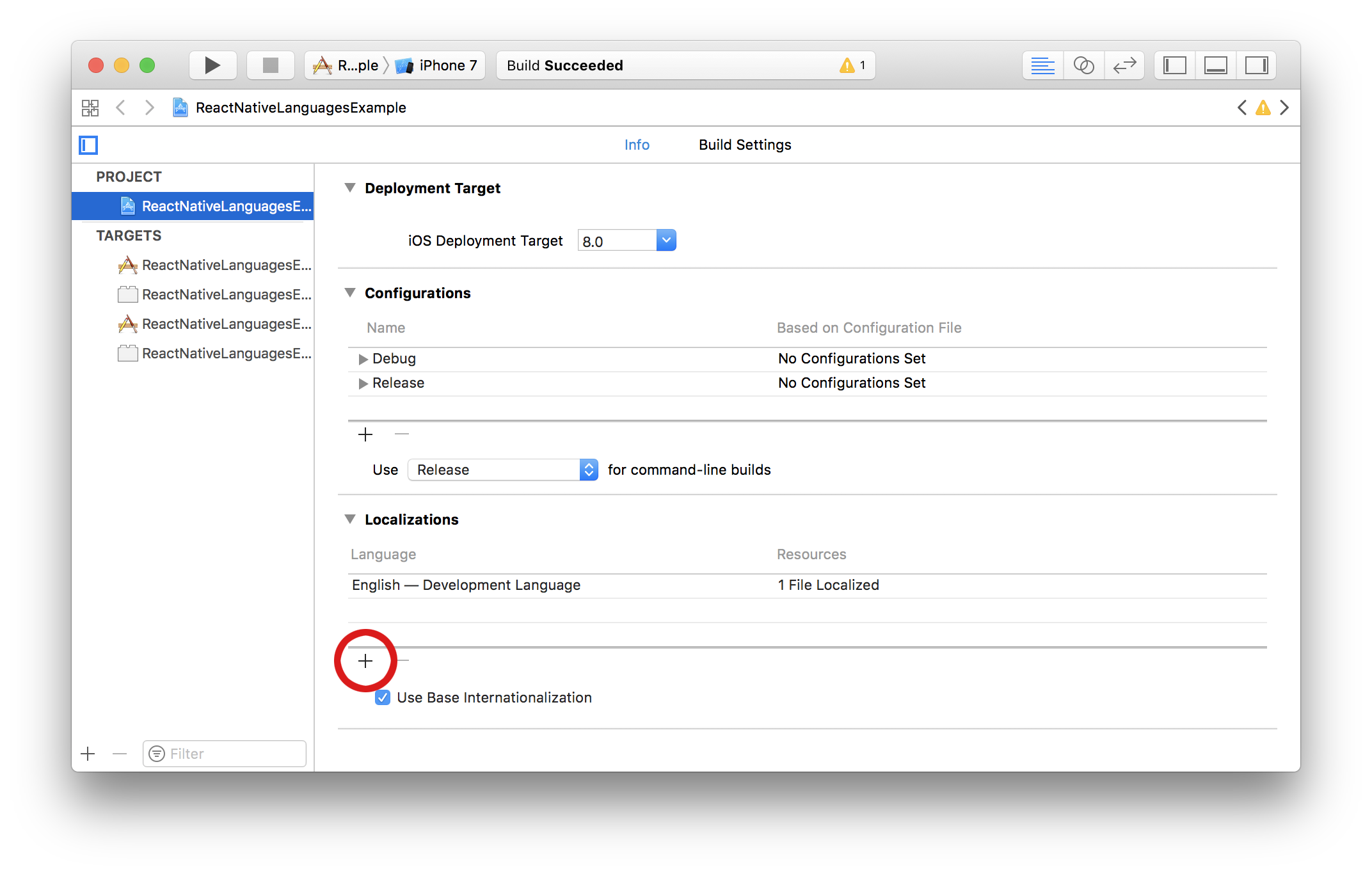
How to update supported localizations (iOS)
You can add / remove supported localizations in your Xcode project infos:
How to test your code
Because it's a native module, you need to mock this package.
The package provides a default mock you may import in your __mocks__ directory:
// __mocks__/react-native-localize.ts
export * from "react-native-localize/mock"; // or "react-native-localize/mock/jest"
Sponsors
This module is provided as is, I work on it in my free time.
If you or your company uses it in a production app, consider sponsoring this project 💰. You also can contact me for premium enterprise support: help with issues, prioritize bugfixes, feature requests, etc.